 By Chuck Dowd
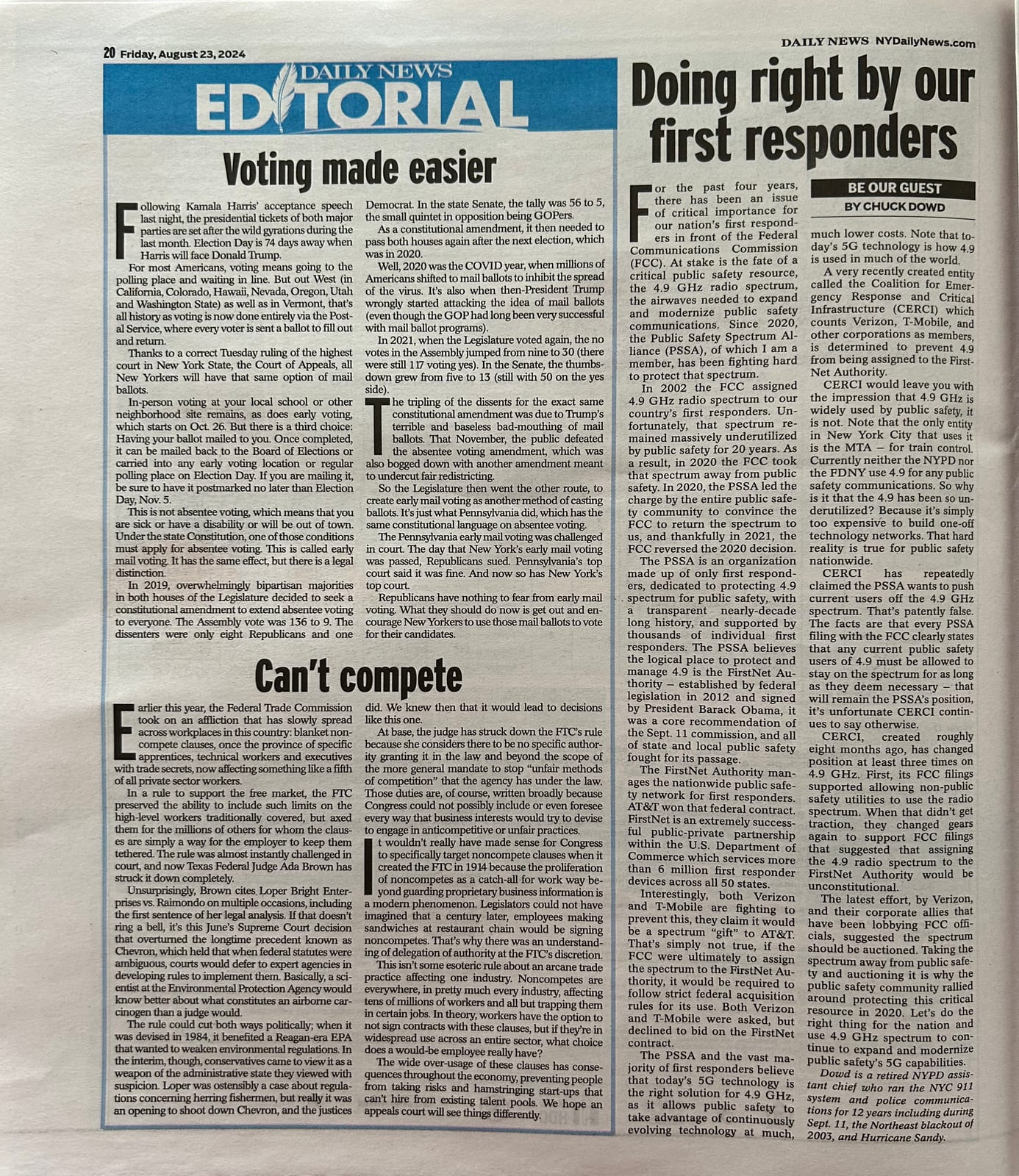
For the past several years, there has been an issue of critical importance for our nation's first responders in front of the Federal Communications Commission: the fate of the 4.9 GHz radio spectrum, the airwaves needed to expand and modernize public safety communications.
The Public Safety Spectrum Alliance (PSSA) — an organization made up entirely of first responders, with a nearly decade-long history of advocacy backed by thousands of individual first responders — has fought to keep that spectrum in the hands of the people who actually use it in an emergency. The PSSA believes the logical home for managing 4.9 GHz is the FirstNet Authority, the nationwide public-safety network established by federal legislation in 2012, recommended by the Sept. 11 Commission, and supported by public safety agencies in all 50 states.
That position has put the PSSA at odds with large telecom interests pushing to open the spectrum to commercial use or auction it off entirely — even though, as Chuck has written, the spectrum remained massively underused by public safety for two decades simply because it was too expensive for individual agencies to build their own networks on it. Routing it through FirstNet's public-private partnership would let departments nationwide take advantage of modern 5G-era technology at a fraction of the cost of building one-off systems.
It's the same argument Chuck makes about public safety technology on Hilton Head Island: the right infrastructure, deployed the right way, protects both the people doing the job and the neighborhoods they serve. Smart cameras, real-time traffic monitoring, and coordinated emergency response aren't abstractions to him — they're the tools he spent a career building and relying on.
This is one in a series of articles sharing Chuck's record on public safety and technology policy, from his decades in New York to the priorities he's bringing to Ward 5.