 By Chuck Dowd
When emergency responders arrive at a crisis, every second depends on whether they can communicate. For a long time, that was far from guaranteed. Local police and fire departments often operated on separate radio frequencies with incompatible equipment, so units answering the same incident could not reliably talk to each other, let alone coordinate with agencies in neighboring communities.
Watch the Episode
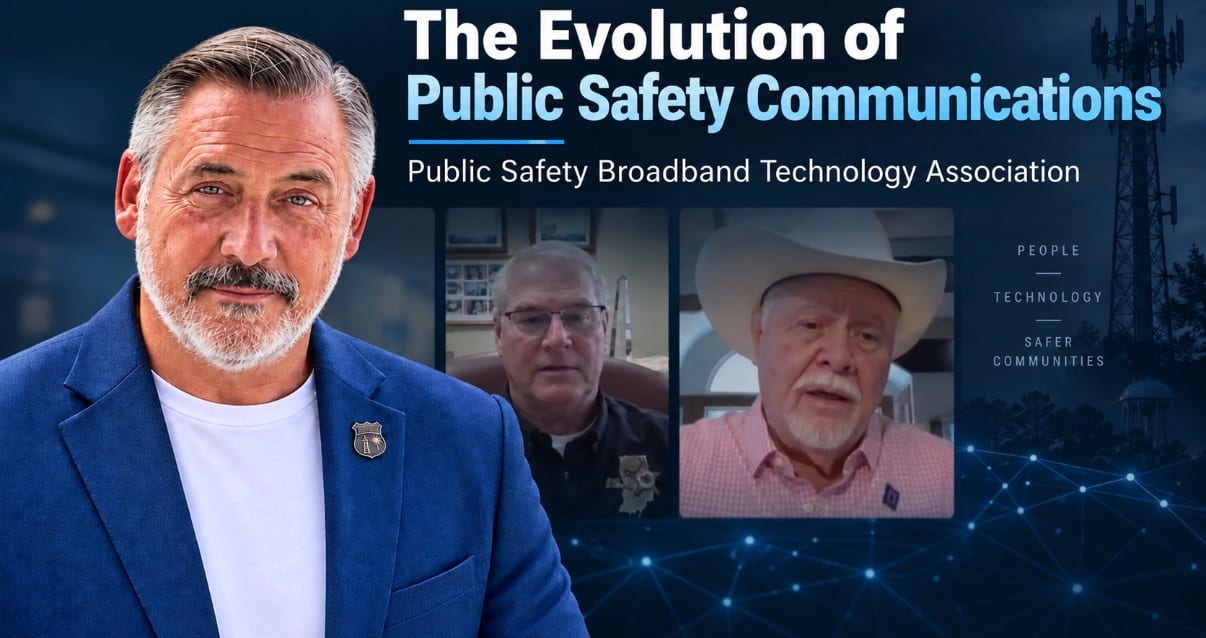
Blue Brief, Episode 3: The Evolution of Public Safety Communications, from Pre-9/11 Gaps to FirstNet Innovation. Produced by the Public Safety Broadband Technology Association (PSBTA).
The Gaps Before 9/11
The lessons of that day pushed the country to rethink how responders communicate. Before the attacks, the problem was not a lack of dedication. It was a lack of shared infrastructure. Each agency built its own radio system, and those systems did not connect with the ones next door. In a major incident, that patchwork meant coordination depended on improvised workarounds instead of a reliable network.
Building FirstNet
Congress established FirstNet in 2012 as a public-private partnership with AT&T. Earlier efforts to build broadband networks one municipality at a time had struggled. FirstNet succeeded where those local efforts did not, by creating a single nationwide system that public safety agencies could join. Today it supports more than 8.2 million lines of service across roughly 31,000 public safety agencies, covering more than 3 million square miles.
Priority When It Matters Most
A standard commercial carrier is built to serve everyone at once, and it can slow to a crawl when a local network is overloaded. FirstNet is different. It operates on dedicated Band 14 spectrum, which gives emergency personnel priority access and preemption, so their communications stay up even when commercial networks are saturated. For a responder on a call, that difference is not theoretical.
Support When Disaster Strikes
The episode also highlights how quickly the network can be extended where it is needed most. After hurricanes along the Florida panhandle, FirstNet deployed mobile assets, including Satellite Cells on Light Trucks (SatCOLTs), to restore voice and data service for search, rescue, and recovery teams. Anyone who has watched a coastal community recover from a storm knows how much those first hours of communication matter.
Keeping Local Voices at the Table
Congress will soon take up the reauthorization of FirstNet, and the leaders featured in the episode are clear about what they want from it. The network should keep developing under the guidance of the state and local agencies that rely on it every day, not be micromanaged from a distant federal office. Chuck's experience commanding public safety communications in New York reinforces that principle. The people answering the call should help decide how the system serves them.
What This Means for Ward 5
Hilton Head Island faces its own emergency realities, from hurricane season to traffic bottlenecks that can delay a response. The same principles that made FirstNet work nationwide apply locally: reliable communications, modern tools, and decisions made by people who understand what responders need. That is the approach Chuck will bring to the Town Council.
To hear the full discussion, listen to Blue Brief, Episode 3 at thepsbta.org.